

How To Install A Larger Window
By Matt Weber
When Bigger is Better.
Replacing old, leaky windows with new gas-filled, multi-paned units is a top project among homeowners with a keen center on energy efficiency. Although saving energy is a great reason for an upgrade, it'southward not the merely ane. The larger a window, the more sunlight can enter and brighten the dwelling house. Furthermore, windows provide an go out in case of emergency, and the pocket-size, elevated windows in my cousin Businesswoman's home motivated him to overstate them equally a safer means of escape for his kids in case of fire.
Increasing the size of the windows was no like shooting fish in a barrel job. The front of the house had a brick façade, which had to be partially demolished to elongate the rough openings and then reconstructed. The sides and rear of the house were sided with EIFS (Outside Insulation & Terminate Organisation), which required an entirely dissimilar procedure for enlarging the window openings. And finally, one of the windows—a double unit of measurement with continuous caput and sill—was wider than the original, which meant we not just had to remove the lower wall to elongate the window, only we had to blow out the male monarch studs and reframe a new header to accommodate the span.
Here's what we encountered on the project, and how we overcame information technology.
Brick Wall Breakdown
We began piece of work on the windows in the brick wall. After removing the panes, nosotros pried upwards the aluminum frame and cut information technology with a recip saw to remove information technology from the framing and brick.

Any time you're penetrating a wall, showtime locate all plumbing and electrical lines and safely disconnect them.
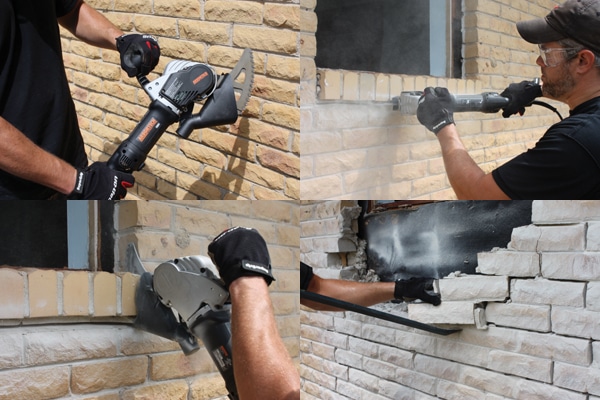
To dismantle the wall nosotros used the Allsaw AS170 brick and mortar saw from Arbortech (world wide web.as170.com). This tool is worth highlighting because information technology saved us hours of labor. It features dual reciprocating mortar blades that plunge into the mortar articulation and rip away the bonding betwixt the bricks. Two different blade sizes allowed u.s.a. to cut both the long horizontal and shorter head joints to remove the brick intact—which we needed to rebuild the wall later. The AS170 provided a swift and organized mode to open the wall without having to resort to the grueling task of chipping with a hammer and chisel.
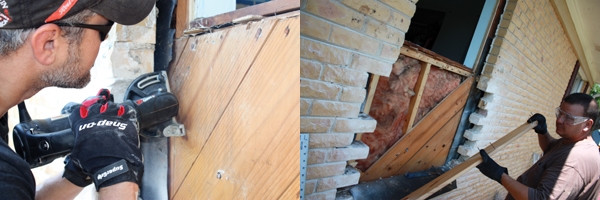
We then removed the house wrap and used a flush-cutting Rotozip to cut the forest capsule in the lower portion of the wall to the dimension of the new rough opening (R.O.). We were keeping the existing header in position, and extending the tiptop of the new windows downward. The R.O. of a window should provide 1/4 in. of infinite— merely no more than than ane/2 in.—around the perimeter of the window unit.
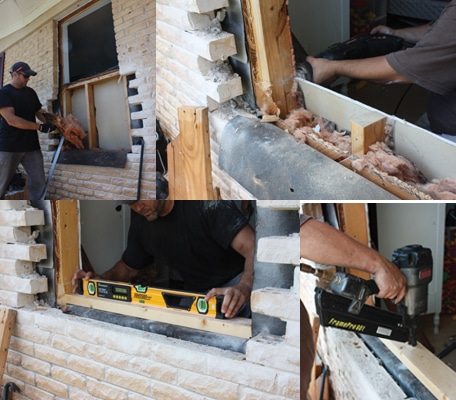
Adjacent, we removed the fiberglass insulation and old sill plate, and cut down the cripple studs to mount the new sill. Level and plumb the sill plate, and double-check that the height betwixt sill plate and header is the correct R.O. dimension for the new window. Spike the sill with framing nails.

To flash the window to divert water, we used aluminum-backed butyl flashing tape, which sticks correct to the framing for easy installation. Flashing combined with properly installed house wrap helps creates a h2o management system to preserve the integrity of the window and surrounding wall.
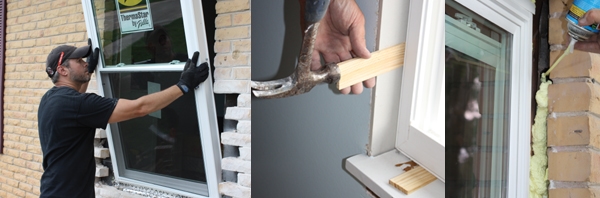
To install the window, position shims along the sill to create a 1/iv-in. gap between the sill plate and window frame to allow for fluctuations in the edifice material and the window. Then tilt the window unit of measurement into the R.O. Square up the window and make certain information technology is level and plumb. Utilize shims every bit necessary to hold the window in position. Follow the manufacturer'due south instructions carefully regarding fastener location. We recommend a corrosion-resistant fastener with a minimum caput size of 5/16 in. that's long plenty to penetrate a structural framing member past at to the lowest degree an inch.
In one case the window is fastened and flashed, insulate betwixt the window and the crude opening with a bead of depression-expansion polyurethane foam sealant. Make certain the sealant is specified for Window and Doors, because the incorrect product can aggrandize also much and warp the frame of the window. The foam helps to create a seal that lowers the gamble of h2o and air infiltration.
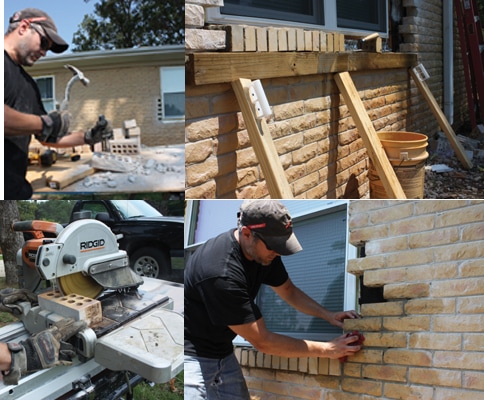
In one case the windows were installed, we had to reconstruct the wall using the old brick. The job first required chipping away all the quondam mortar from the bricks with a hammer and cold chisel. We mixed up some new mortar and re-laid the brick from bottom upward. To help hold the ledge in place while the mortar dried, we erected a temporary brace fabricated of chip 2x4s. When it was necessary to cut a brick, we used a moisture saw equipped with a diamond-dust blade (although a hammer and brick ready will also work). We replaced the brick around the window perimeter, adjustment them with the edges of the undisturbed brick from the upper half of the opening.
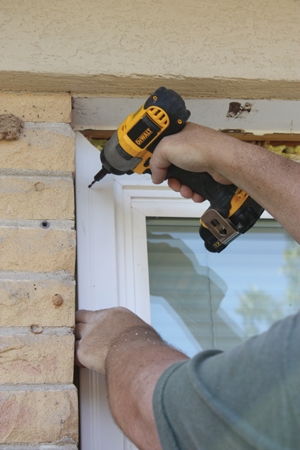
The terminal phase for the bricked-in windows was to install mitered brick moulding around the edge. The trim was followed with a liberal awarding of waterproof sealant.
EIFS: A Different Approach
EIFS siding systems are oft chosen "synthetic stucco." When installed over wood sheathing, these systems normally consist of a layer of insulation board followed by a layer of reinforcing mesh that is embedded in an adhesive base glaze of constructed production. The base coat is followed with a finish coat that gives the siding its color and usually a stucco-like texture.
When disturbing an EIFS-sided wall, information technology's best to go on cautiously because it'due south difficult to make repairs await natural.
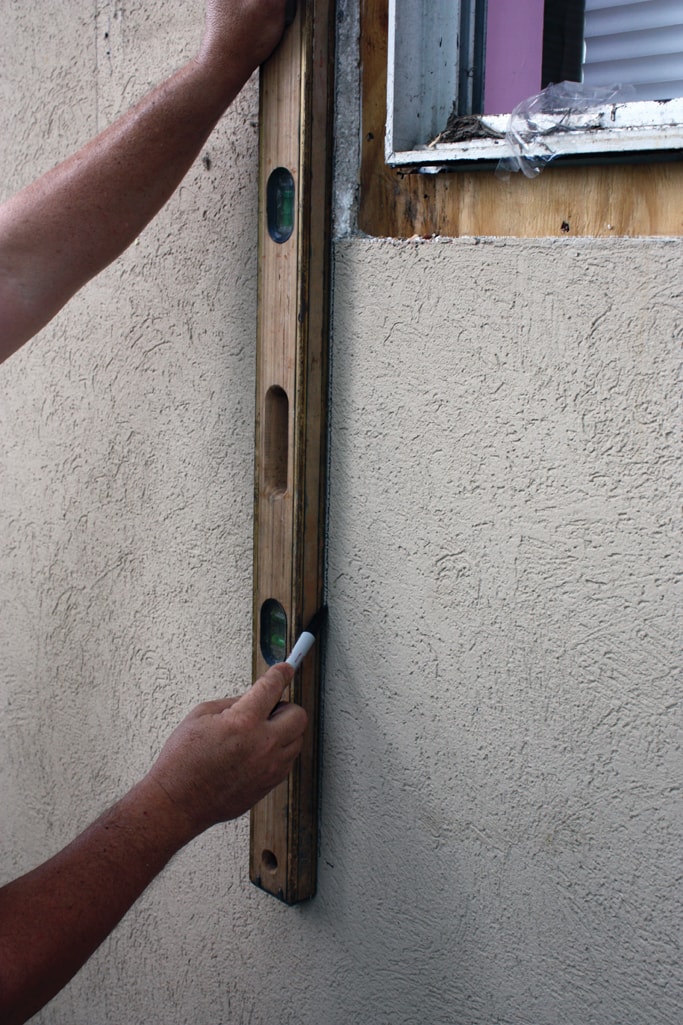
We carefully extended the side lines of the existing R.O. downwards using a 4-ft. level and a carpenter's pencil.
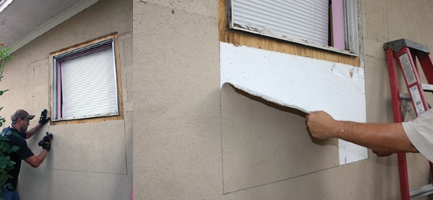
I and so used a Bosch Multi-10 aquiver tool with a masonry blade to follow the cut lines of the new R.O., cutting through the outer layers of EIFS and into the insulating layer, which in this instance was 3/4-in. Styrofoam. Once cut, the EIFS layers pulled abroad easily.
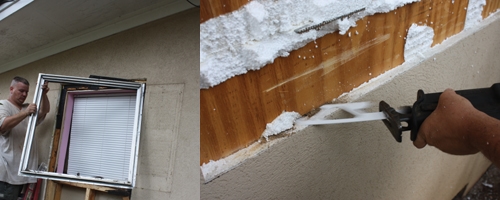
I so used a recip saw equipped with a new Milwaukee Flush-Cut Blade to cut away the sheathing affluent with the edge of the EIFS. Next came removal of the one-time window, sill plate and cripple studs.
Once you've reconstructed the new R.O., utilise flashing and shims as necessary to accomplish the 1/4-in. expansion gap around all sides of the opening.

For the side and rear windows, Baron wanted to dress out the new units with an enhanced trim packet to provide a classier look and conceal any accidental damage to the surrounding stucco-like finish. To attain this motorbus trim arroyo, we ordered the new Brickmould 600 series for Simonton Windows. These are actually new-construction windows, rather than typical replacement windows. This means they have a nailing flange that is typically fastened within the wall and then covered with sheathing/siding. However, the Brickmould 600s likewise come up consummate with brick mould trim already attached at the factory. Past combining the pre-attached brick mould with some additional 1×iv PVC casing, we were able to use the nailing flange to fasten the window to the framing while concealing the flange with the casing. This combination provided a good decorative blueprint for our project, even if using new-structure windows in this manner is somewhat unorthodox.
Alert: Installing new-construction windows using this method requires a nearby overhang to divert rainwater abroad from the acme flange. In our example, the roof ledge located immediately higher up the window would shed water. Otherwise, but upgrade your home with replacement windows.
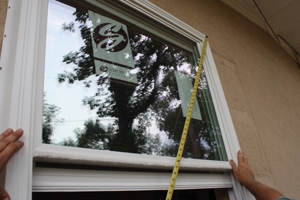
To check that the window is square, measure the frame diagonally. Measure from the summit left corner of the frame to the bottom right corner, and from the top right to lesser left. If the measurements are equal, the window is square.
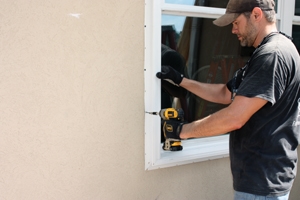
We ran a continuous bead of sealant (roughly 1/2-in. thick) effectually the within perimeter of the mounting flange (aligned with pre-punched holes). Since we were fastening the flange through the EIFS, we used 3-in. non-corrosive fasteners to bite solidly into the structural framing.
The window was completed by adding the mitered i×4 PVC casement over the flange and inside the groove behind the brick moulding.
Tear Down the Walls
Our final replacement window posed the claiming of existence not only longer, simply 79-1/2-in. wide, which was wider than the existing R.O. This new wrinkle required us to open upwards the walls to expand the king studs that framed each side of the window, which in turn required united states to construct a new header. This required major demolition with a recip saw, a couple of pry bars and nail-pulling pliers. We cut away the interior drywall with a utility knife.
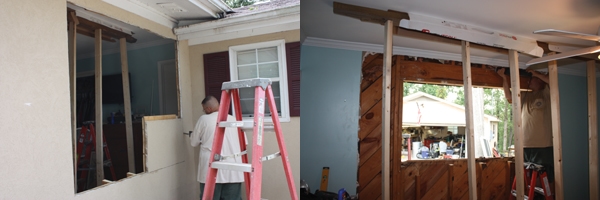
Suffice information technology to say that when a DIY'er is faced with cut the framing of a load-bearing wall, it's advisable to consult a structural engineer on how to continue. At the very to the lowest degree the chore requires building a temporary brace wall to support the ceiling while the existing studs and header are removed and rebuilt. The temporary wall must exist built wide plenty to span across the house studs that volition remain on both sides of the surface area to be removed. Build it roughly iii ft. parallel to the existing wall to allow some room to work.
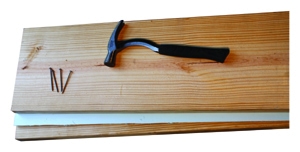
A header is doubled 2x material above the window that distributes the weight of the structural framing above. The header is supported by the trimmer studs (run into diagram). Always make the header exactly equally thick every bit the door frame—for instance, 2 2×4 boards sandwiching ane/2-in. plywood or rigid foam sheeting cut to the aforementioned dimensions.
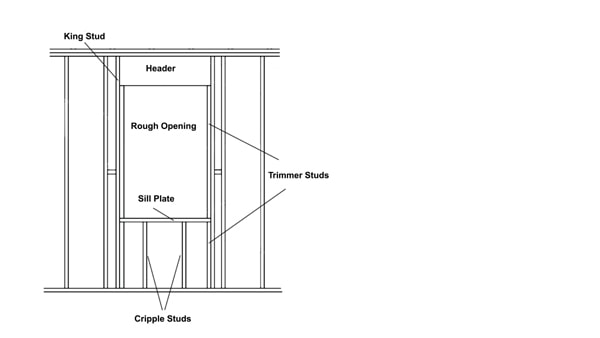
The size of the header will be determined by the bridge of the window, and whether or not it is a load-bearing wall. Assuming you're using a species of wood at least every bit strong as No. 2 Douglas fir, a doubled 2×iv (4×4) is adequate for a load-bearing opening of 48 in. or less. The required header size increases as the span gets wider, and our 80-in. R.O. required a 4×eight header.
Here are some common span sizes for windows and doors:
| Lumber Size | Species | Min. grade | Max. span |
| 4×4 | Bandbox, Pino, Fir | No. ii | 48″ |
| 4×6 | SPF | No. two | 72″ |
| four×viii | SPF | No. two | 96″ |
| iv×10 | SPF | No. 2 | x′ |
| 4×12 | SPF | No. 2 | 12′ |
Afterward nosotros rebuilt the wall with the new header, studs and sill plate, we replaced the window in the same manner that we did with the other EIFS walls of the home.Once the job was complete, the deviation was dramatic. Baron's two kids—Ben and Abigail—bask the expanded chamber view and the warm sunlight the windows bring into the firm. Plus, the double-hung, Low-E/argon-filled windows are more energy efficient, easier to make clean and easier to open in case of emergency.
 SIDE NOTE :
Windows of a Different Color
Builders can go more stylized options on their windows with Simonton Windows' Brickmould 600 product line, including exterior frame and flat casing trim for windows and patio doors in Brick, Chocolate, Bronze, Cream, Driftwood, Pine and Tan. The exterior colors have a 10-year warranty against peeling, flaking, chipping, blistering and corrosion. Additional enhancements to the Brickmould 600 serial include premium hardware interior finishes such equally Brushed Nickel, Oil-Rubbed Bronze and Polished Contumely, to go along with the already bachelor Light or Nighttime Oak woodgrain interior laminates. Visit world wide web.simonton.com.

Source: https://extremehowto.com/replacing-windows-with-larger-units/
Posted by: wootencized1957.blogspot.com
0 Response to "How To Install A Larger Window"
Post a Comment