

How To Install Fitech Fuel Injection
Unless you've been driving a Prius every twenty-four hour period and snacking on tree bark and trail mix, then yous know that EFI conversions have been one of the hottest upgrades y'all can practise on a classic motorcar or truck. What used to accept hours scrounging around a wrecking thou, trying to find all of the right components, has now go a i-box kit that includes everything needed to put y'all on the path to better starts, smoother idle, improved throttle response, and increased fuel economic system.
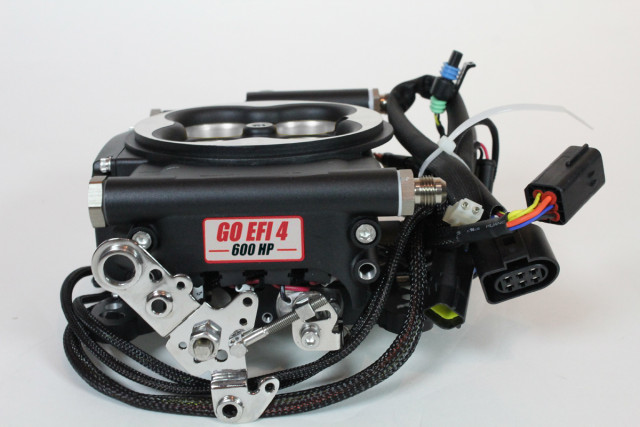
The GO EFI 4 will support upward to 600 horsepower, and retails at $995.00.
While many EFI systems seem to exist competing with other EFI's systems, FiTech Fuel Injection is aiming to toll its base EFI conversion system to be competitive with the cost of a new carburetor. Its goal is to make EFI conversions and so simple that all you have to do is bolt the unit up, connect a few wires, and you lot're prepare.
With new base systems like the EFI iv throttle torso conversion currently selling for $995.00, FiTech President Ken Farrell says there are plans for entry-level pricing a fleck lower than that – how does $795 sound? Beginning with just a couple of EFI systems as niggling every bit 2 years ago, FiTech now has systems supporting engines with upwardly to 1,200 horsepower, dual quad, nitrous, boosted, and even E85 (with some adjustments that tin be made on the handheld controller).
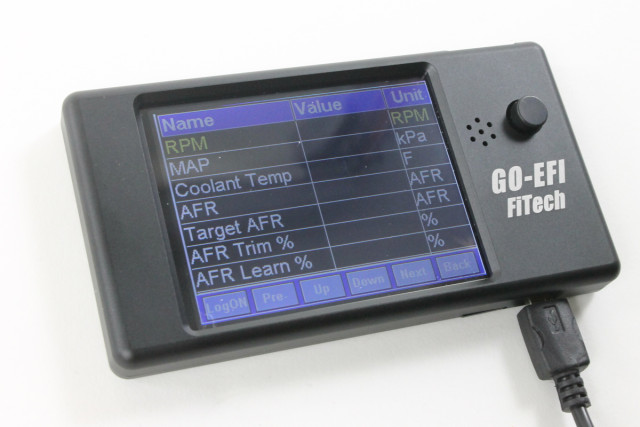
High tech? Certain, but FiTech has done all the piece of work for you. You only need to respond a few questions and set a couple of parameters, and you're gear up to Go-EFI.
Your Commencement EFI Conversion: What Do You lot Demand To Know?
While the carburetor market hasn't died down, there are withal enough of gearheads out in that location that FiTech wants to convert. The street rod and musclecar communities are becoming more and more than enlightened of what's out in that location, and nonetheless in that location is all the same that age-former assumption of using a laptop to make your EFI conversion piece of work properly. FiTech wants its potential customers to know that they have done all of the hard work for you, and that you don't fifty-fifty demand to own a computer, let alone a laptop, to convert to a FiTech EFI organisation.
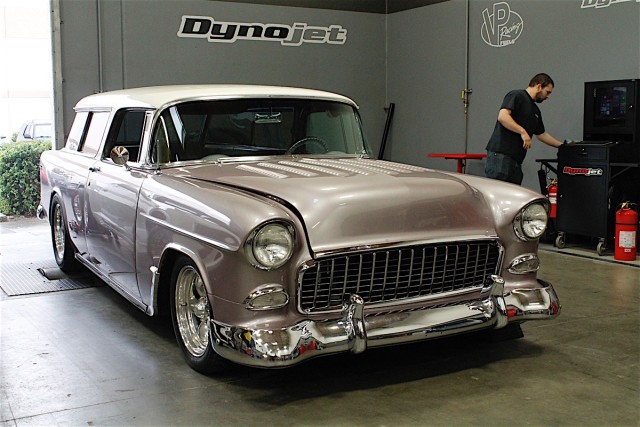
We brought in Mark Thomas and his 1955 Chevrolet Nomad to convert him over to EFI. With a potent SBC putting down a piddling over 294 horsepower to the rear wheels, Marker had a few questions for Farrell and Schmidt when he brought his car in. Every bit a first-time carb-to-EFI recipient, he was concerned about how much would need to exist washed with regards to the ignition, timing, and fuel delivery system. We assured him that he was in expert hands with guys from FiTech.
The first concern with an EFI conversion is whether information technology will really be a direct replacement for the carburetor. Of class, things similar fuel pressure, wide band O2 sensor, and an ECU are part of the conversion, only FiTech takes care of these items in its kits. At that place is additional wiring, but that, too, is role of the kit and all wiring is terminated where it volition plug into a sensor or fuel injector, and it'due south covered with a protective sleeve.
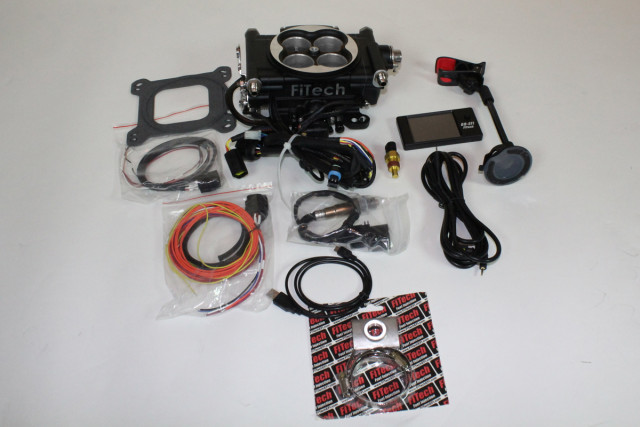
FiTech Go-EFI 4
EFI kit components:
- Die-bandage throttle body
- Hand-held controller
- Windshield mount
- Four hello-period 600 HP injectors
- Congenital-in pressure regulator
- 2.5 BAR internal MAP sensor
- Throttle position sensor
- Idle air control
- Coolant temp sensor
- Wide ring O2 sensor
- O2 bung kit
- -06AN Fuel inlet fitting
- Gasket kit
A FiTech EFI conversion will piece of work with basically any carbureted application with a 4150-style flange on the intake manifold. The Street EFI system works very much like swapping out to a newer carburetor in that it does non require whatsoever modifications to be fabricated to the existing timing command.
"Limitations are usually based on client comfort level and the organisation purchased," Farrell said. "Our Street systems exercise non have timing command and use simply a tachometer signal for RPM output."
For a first time EFI installer, bones noesis and skills would be the requirement to install your own system. If you can install a carburetor, water pump, or fuel pump, you've likely got the minimum skillset necessary to convert to a FiTech Street EFI organization.
The next step up, the Become EFI organization, has timing control also as fuel command, so the customer should practise but what they are comfy with. Farrell said, "If he is non using heave or nitrous, then letting the benefactor control the timing is actually a good selection for simplicity."
The basic connections for the EFI are a hot 12 volts, switched 12 volts, chassis footing, tachometer input, and an ignition input that sees 12 volts during cranking and run conditions. Every bit for the ECU, FiTech mounts it straight to the throttle body, and all necessary sensors are either office of the throttle trunk – like air temperature, throttle position sensor, idle air control valve, and fuel injectors – or they are included, such as the wide band O2 sensor and the cooling temperature sender.
The fuel control center is a self-contained sump tank that stores fuel for the EFI, meaning fuel slosh won't bear on drivability – even with the manufactory fuel tank.
FiTech Fuel Command Middle
Ane component of the FiTech system is the fuel command eye, which is substantially a fuel sump tank that houses the high pressure level fuel pump and a pair of pressure gauges. The fuel command centre is fed by the low pressure level fuel pump (either inline electrical or mechanical) used by the carburetor as a elevator pump to make full the reservoir with fuel. Inside, the loftier force per unit area fuel pump feeds the fuel injectors on the throttle trunk.
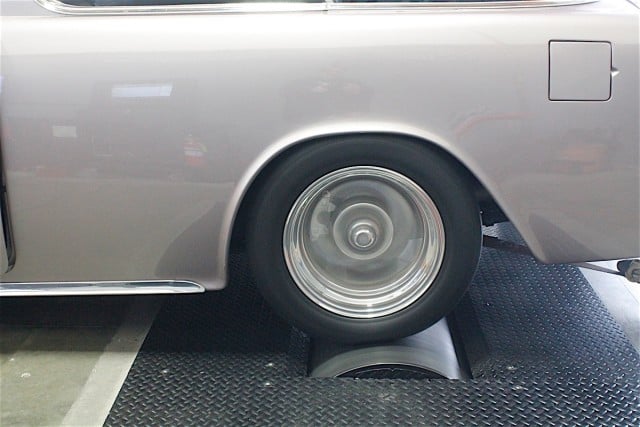
We brought the Nomad in the shop for the first time to help programme out the EFI conversion, and also to get some base numbers with the carburetor installed.
When we get-go brought the Nomad into the store, it was not to install the EFI system, simply to take an opportunity to plan out the installation. That's an important aspect of whatever upgrade, and with an EFI system information technology's highly recommended so that the install can be planned out, every bit this tin essentially can save a couple to a few hours, especially when it comes to mounting the fuel command middle.
If at that place isn't enough room under the hood to mount the fuel command center, planning ahead will save time when it comes to the installation in case some things need to be moved. The fuel command center isn't a very large component, just information technology does shop fuel so that the throttle body is never starved. While fuel may exist sloshing effectually in the stock, non-baffled tank, that won't be a problem for fuel injection because the fuel command center stores plenty fuel to supply the throttle torso, much like a bowl stores it for a carburetor.
We found a perfect location for the command center, and mounted it away from excessive heat or moving components. It can be mounted anywhere under the hood or even on the chassis. A vent line from the command center to the filler pipe is the only connectedness back to the fuel tank.
While this component isn't admittedly necessary in gild to install a FiTech EFI conversion, it saves a lot of headache working with a factory tank that is not baffled to keep fuel near the pick-upwardly. The alternative to the fuel command middle would exist to install an aftermarket, in-tank fuel pump kit, or an aftermarket tank that is baffled to avoid fuel starvation issues.
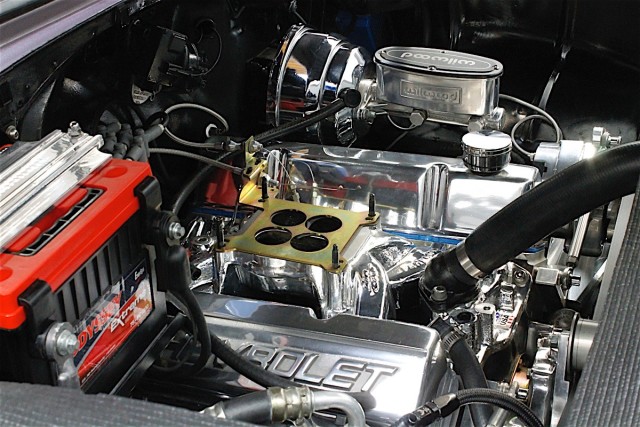
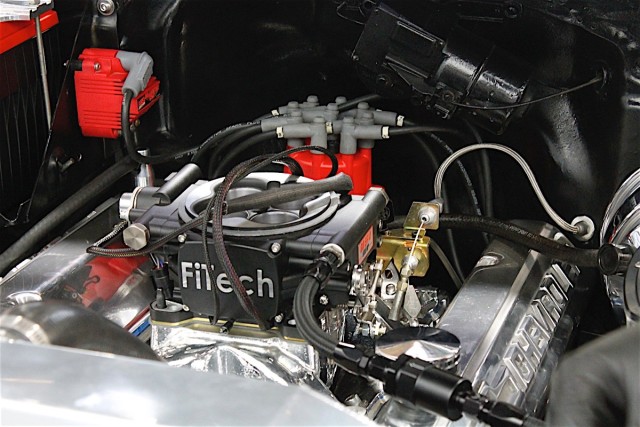 FiTech EFI Installation
With the fuel command center mounted, we so mapped out the fuel lines and where to route them. The throttle body is adaptable, so if the fuel command center ends up on the right or left side of the engine bay, the fittings can be swapped out to connect the loftier pressure level fuel line to that side of the throttle torso. From there, information technology was time to pull off the old carburetor and begin the process for the FiTech EFI conversion.
FiTech includes a pair of clamps and a bung to install the O2 sensor. Because this requires a hole to be drilled into the frazzle pipe, the included plate tin exist clamped into identify or welded, allowing you to attach the O2 sensor and then you tin drive to a shop to take the welding done. Alternatively, you can cull to go on it clamped to the pipe without welding.
You don't need to be able to weld to install the O2 sensor because a clench kit and gasket will suffice. Welding, however, provides a more permanent installation.
We first marked a hole for the piping, then drilled the hole to fit the sensor, and tack-welded the plate into position before welding the circumference of the O2 plate. The FiTech system uses the latest Bosch-manner half dozen-wire wide band sensor, which will aid the ECU to make adjustments every bit you drive.
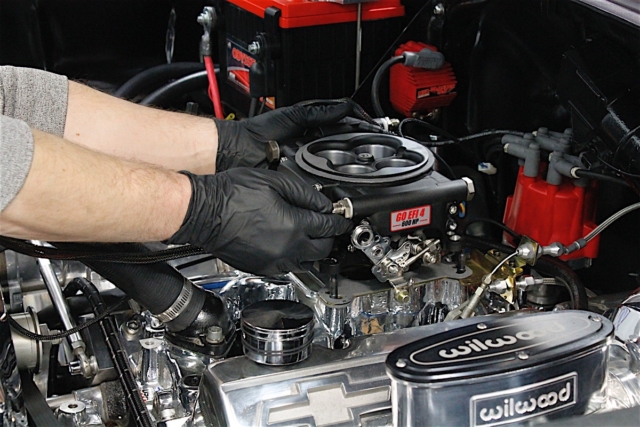
Whatsoever intake with a 4150-style carburetor flange volition accept the FiTech throttle trunk.
The throttle body bolts directly to a 4150-manner intake manifold, and the throttle lever is the typical carburetor-style that can accept most throttle cables and kickdown levers. Depending on your existing setup, you may need to exist a little creative with your cables/levers, but much of that is based on the cable system being used. It volition operate in similar mode as it does on a carburetor.
Electrical wiring is labeled and covered, with pre-terminated ends for the O2 sensor, temperature sensor, and all throttle torso connections. The supplied ring terminals and wiring for the fuel control center enables cutting the wiring to length, and the manus-held controller plugs directly into the harness. The controller can be mounted anywhere within the vehicle, if desired, and includes a mount to hold the controller in place while adjustments are made.
Most of the included sensors are mounted on the throttle body. The temperature sensor mounts in the intake manifold, and the harness plugs directly into each sensor for a clean installation.
With all of our wiring completed, the next pace was to fire upward the car, let the computer self-learn and make some adjustments, and line up on the rollers to come across where we were at. Our initial run prior to installing the FiTech EFI system showed united states of america a very fat fuel curve. While it put downwardly some decent numbers, information technology showed us that nosotros were a little likewise thick on the fuel and needed to lean it out a little.
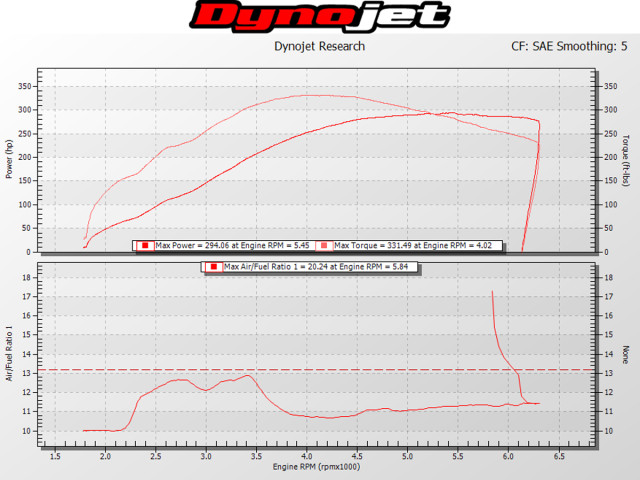
The baseline run before the EFI conversion put downwardly a respectable 294.06 horsepower at the rear wheels, and 331.49 lb-ft of torque.
Concluding Dyno Run And Results
With our commencement pass on the dyno, we were sitting at nearly 294.06 horsepower at the rear wheels, and 331.49 lb-ft of torque. It was pretty potent, simply what concerned u.s.a. was the air/fuel ratio (A/FR). Sitting at about 10:1 at idle, off-idle jumped to about 12:1 and and so it richened up to under 11:1 and stayed well under 12:1 for near of the run when the throttle was pressed. That'southward better than being as well lean, just we wanted to come across if we could clean upwards that fuel ratio and get a couple of more than ponies at the wheels.
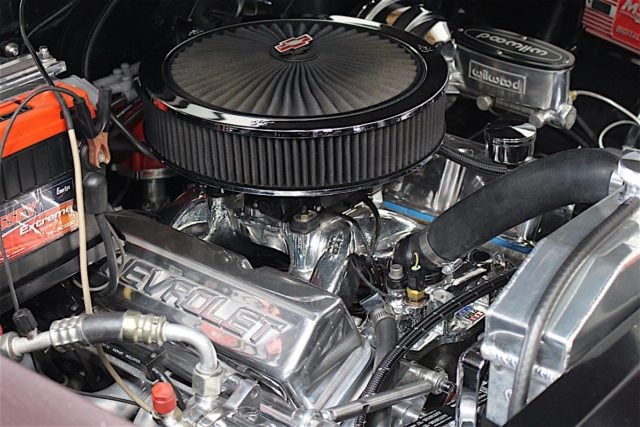
At first glance, you'd be hard pressed to identify the FiTech EFI system under that air cleaner.
EFI conversions are, for the most role, done for drivability, fuel economic system, and for smoother idle and amend starts. We brought the Nomad back on the rollers after a little bit of driving to allow the ECU to learn and brand some adjustments. Almost immediately we saw an comeback in the A/FR.
Farrell recommends that right out of the gate the vehicle should be driven relatively normal to give the ECU time to learn. As a cocky-learning ECU, the feedback from the wide band O2 sensor volition help the ECU make adjustments based on things like A/FR, throttle position, air temperature, and engine speed.
As you lot drive, the computer is constantly making adjustments to provide the best combination. Later a few miles, Farrell says you can bulldoze information technology difficult, and the reckoner will continue to learn. "The organization will learn and suit in minutes and striking all the points in a few miles of driving, as long as yous hitting all load points and RPM points," he said. "Nosotros send the ECU with a really good setup," Farrell said, "but you tin can change those A/FRs to optimize your tune. All cams are unlike and so it's a loaded question to enquire what is the best setting."
The system volition learn and adapt in minutes and hitting all the points in a few miles of driving, every bit long every bit you lot hit all load points and RPM points. – Ken Farrell, FiTech Fuel Injection

For cruising, usually something around xiv:one is acceptable to provide better economy, with only under fourteen:1 for idle. For wide open throttle, getting the fuel curve down to 12.five:1 is a safe bet, and the FiTech EFI will gradually build up to a richer mixture when the throttle is pressed.
When the Nomad fired up and began to spin the rollers, we were able to come away with 311.47 RWHP and 353.56 lb-ft of torque. But more importantly, our A/FR was coming in at a leaner setting and during the heavy throttle weather condition we saw a more respectable A/FR that was in the 11-12:one range. With the FiTech EFI conversion, Thomas was excited seeing an increase of 17.41 RWHP and 22.07 lb-ft of torque.
As we mentioned, EFI conversions aren't necessarily going to guaranty an increment in power or torque, simply cleaning up the A/FR and running more efficiently, our Nomad was able to put down better numbers and better throttle response, making this get-go-fourth dimension EFI convert a very happy owner.
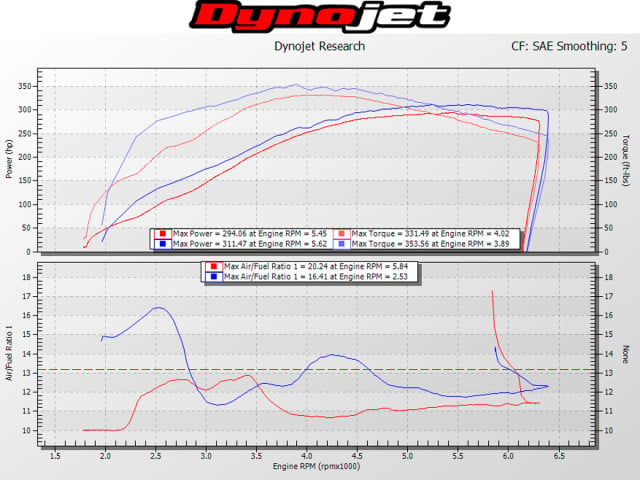
After allowing the FiTech EFI to learn a piddling from the wide band O2 sensor's readings, the Nomad upped its street credo by putting down 311.47 horsepower and 353.56 lb-ft of torque, an increase of 17 RWHP and 22 lb-ft of torque. A more efficient engine, tin be a more potent engine.
Nosotros're told FiTech will release its new $795 EFI system kickoff in Apr of this year, and they have several other systems supporting 300 to 1,200 horsepower on their website. Keep up with news and the latest events from FiTech by visiting and liking their Facebook page.
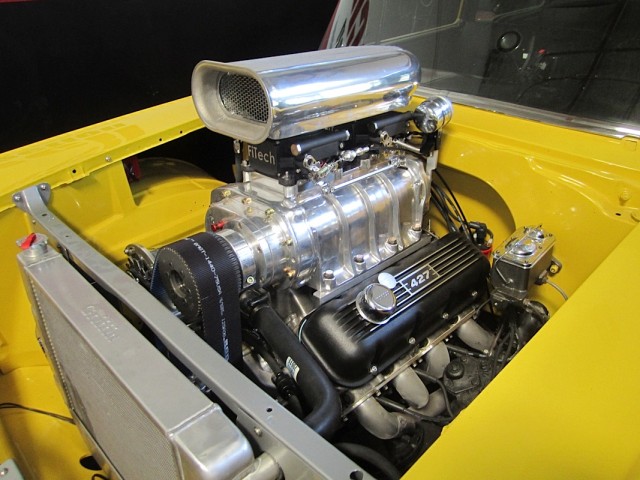
A bit more avant-garde, FiTech's examination mule is a diddled 427 cubic inch Chevy.

Source: https://www.streetmusclemag.com/tech-stories/electronics-efi/fitech-efi-what-you-should-know-about-your-first-efi-conversion/
Posted by: wootencized1957.blogspot.com
0 Response to "How To Install Fitech Fuel Injection"
Post a Comment