

How To Repair Filiform Corrosion
Filiform corrosion is a particular form of corrosion that occurs under thin coatings in randomly distributed threads like filaments. Filiform corrosion is also known as underfilm corrosion, filamentary corrosion or worm rail corrosion. In this article we examine the causes of filiform corrosion, where information technology typically appears, how it develops, how to detect it and how to prevent it from occurring.
What is filiform corrosion?
Filiform corrosion occurs on metallic surfaces that are coated with a sparse organic picture, typically 0.05 to 0.one mm (ii to 4 mils) thick, when exposed to a warm, humid atmospheric air. Filiform corrosion always starts at coating defects such every bit scratches and weak points such every bit beards, cut edges and holes. (Check out our costless Coating Failures and Defects Guide.)
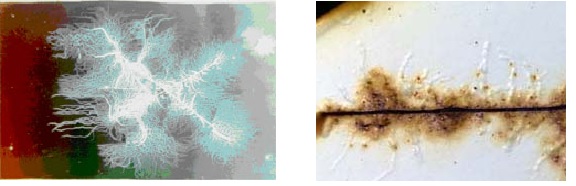 Effigy 1. The filamentous nature of filiform corrosion (left). Filiform corrosion tunnels forming under a coating (right).
Source: NASA Corrosion Engineering Laboratory
How Filiform Corrosion Occurs
In many respects, filiform corrosion on aluminum (Al) and magnesium (Mg) is similar to corrosion on steel. Filiform corrosion is driven by the germination of differential aeration cells at defect sites on coated substrates.
The filiform cell consists of an active head and a tail that receives oxygen and condensed water vapor through cracks in the applied coating. The head may be filled with alumina gel and gas bubbles in aluminum if the head is very acidic. In magnesium, the head appears blackish considering of the magnesium etching, only the corrosive fluid is clear when the head is broken. Filiform tails in aluminum and magnesium are whitish in appearance. The corrosion products are hydroxides and oxides of aluminum and magnesium, respectively. Anodic reactions produce Al3+ or Mgtwo+ ions, which react to form insoluble precipitates with the hydroxyl ions produced in the oxygen-reduction reaction occurring predominately in the tail.
The machinery of initiation and activation in aluminum and magnesium are essentially the same every bit for coated steel. The acidified head is a moving pool of electrolytes, but the tail is a region in which aluminum ions are transported and a gradual reaction with hydroxyl ions occurs. The final corrosion products are partially hydrated and fully expanded in the porous tail. The tail'due south head and middle sections are respective locations for the various initial reactant ions and the intermediate products of corroding aluminum in aqueous media. (To learn more, read Aluminum Corrosion: 5 Incredible Facts Yous Must Know.)
In contrast to steel, aluminum and magnesium show a greater tendency to form blisters in acidic media, with hydrogen gas evolved in cathodic reactions in the head region. The tail's corrosion products are either aluminum trihydroxide Al(OH)3, a whitish gelled precipitate, or magnesium hydroxide Mg(OH)two, a whitish precipitate.
Factors Affecting Filiform Corrosion
Various factors affect the initiation of filiform corrosion, including:
The nature of the coating
Filiform corrosion occurs with all types of paints: acrylic lacquers, epoxy-polyamides, epoxy-amines and polyurethanes, and with whatever the classic way of application, whether it exist liquid paint or electrostatic powdering. It does not occur under sealed coatings such as electrician's tape.
The surface preparation
This is a significant factor. Filiform corrosion develops on metal that has received no surface preparation, poor training or metal whose surface has been contaminated earlier painting.
The nature of the alloy
The alloy'due south nature is not an essential cistron considering filiform corrosion may affect all aluminum alloys. A recent collaborative report conducted past three European companies, Alusuisse, Hydro Aluminium and Pechiney, showed that for the near ordinarily used alloys in the structure industry, Aluminum 6060 and 6063, the alloy composition has no influence, except when the copper concentration exceeds 0.one%.
Where Filiform Corrosion is About Probable to Develop
Typically, filiform corrosion is severe in warm coastal and tropical regions that experience salt fall or heavily polluted industrial areas. Rougher surfaces likewise feel a greater severity of filiform corrosion. The filiform corrosion typically occurs on aluminum alloys when the humidity level is between 75% - 90% and in a temperature range of xx°C – 40°C (68°F – 104°F), and growth accelerates at 85% relative humidity (RH) level. The relative humidity of the temper is the single about crucial cistron to initiate filiform corrosion. (Related reading: The five Factors of Atmospheric Corrosion.)
The other principal parameters governing filiform corrosion are alloy compositions, scalping of ingots and billets, heat treatments, condition of the metal surface layer, temperature, grinding, pickling and preliminary surface treatment. Although the thickness of the organic coating and the temperature play a pocket-sized role in initiating filiform corrosion, increasing the temperature will increment the filament growth if the relative humidity stays within the critical range.
How to Detect Filiform Corrosion
Filiform corrosion can be visually recognized without using a microscope. It has been observed on coated steel, aluminum and magnesium with a sparse coating of can, gold, silver, phosphate, enamel or lacquer.
The standard exam to place resistance for filiform corrosion in the United States is ASTM D 2803, "Guide for Testing Filiform Corrosion Resistance of Organic Coatings on Metal." Per this test, coated metal specimens are scribed to bare metallic and subjected to a common salt fog atmosphere for up to 24 hours, rinsed in distilled water, and and so placed moisture in a closed cabinet at 25°C (77°F) and 85% RH. The fourth dimension of exposure typically varies from 100 to 1000 hours. The exam results show whether the coated material develops filiform corrosion.
Industries Most Affected by Filiform Corrosion
Aircraft structural components are fastened with bolts and rivets. These fasteners and other precipitous skin edges are mutual initiation points for filiform corrosion. It has been reported that shipping operating in warm, marine environments sustain considerable corrosion damage, particularly on 2024 and 7000 aluminum alloys coated with polyurethane and other coatings.
Humidity is the almost critical variable for the corrosion to propagate considering this is necessary to deliquesce the table salt ions.
The corrosion typically starts where at that place is an imperfection in the substrate and coating layer. The imperfection tin can be introduced from a scratch or a rock chip that weakens the adhesive bond betwixt the substrate and the blanket.
The corrosion starts at this locus, which forms the caput of the corrosion defect. The corrosion normally appears as a distinct thread-like filament, like a worm rails, that appears nether the blanket surface.
The damage is not extensive to the aluminum merely is cosmetically objectionable, especially when the track is long and white in color.
This type of filiform corrosion can harm all types of aluminum products such every bit wheels, car bodies and aircraft. To repair the damage requires sanding and applying a new layer of coating. To forbid filiform corrosion, proper surface pretreatment is required.
The filiform corrosion was more astringent when chloride concentrations on metal were high, mainly when the aircraft ofttimes flew over the ocean or were based in coastal airfield hangers.
Aluminum is widely used for cans and other types of packaging. Aluminum foil is frequently laminated to paper or paperboard to form a moisture or vapor barrier. If the aluminum foil has been eaten by filiform corrosion, the production may go contaminated or dried out because the vapor barrier was broken. Degradation of foiled-laminated paperboard could occur during its production or subsequent storage in a moist environment.
In the automotive manufacture, forged, distinctive calorie-free-alloy wheels with twin tone surfaces (polished sections) and/or polished surfaces show an increased tendency for filiform corrosion.
How to Prevent Filiform Corrosion
Typically, filiform corrosion can be prevented by reducing the relative humidity below 60%. Unfortunately, it is not applied to straight reduce the humidity on moving objects such as shipping and automobiles. Notwithstanding, the humidity level for components kept in a long-term storage facility can easily be controlled by adding drying fans and humidistats, or by adding desiccants to plastic packaging.
Components primed with two layers of epoxy coating systems and ii polyurethane coats are better able to resist filiform corrosion than single coated systems.
The chance of filiform corrosion is reduced when the steel substrate is galvanized. Zinc-rich primers and chromated and phosphatized primers, with tough, irksome curing intermediate coats of polyurethane and epoxy, take reduced filiform susceptibility on steel substrates. Zinc chromate primers, chromic acid anodizing, and chromate or chromate-phosphate conversion coatings take provided varying degrees of relief from filiform corrosion in aluminum alloys. (Another option is discussed in the article Advances in Liquid Nylon Multipolymer Coatings for the Transportation and Renewable Energy Industries.)
Multiple coats on metal surfaces tiresome the diffusion of moisture and have fewer penetration and defect sites than single-glaze paint systems. Multi-coat systems resist penetration past mechanical abrasion and have fewer hills and valleys. Thicker coatings achieved by layer buildup and slower curing have demonstrated substantially better resistance to filiform corrosion by decreasing oxygen and moisture penetration, decreased solvent entrapment, and fewer initiation sites. Powder coating systems are as well beneficial because they are thermally fused, resulting in tough coatings with meliorate resistance to moisture permeability. Smooth, well-prepared primed metal surfaces generally have amend resistance than rougher surfaces.
Steel, aluminum and magnesium are all chemically active. Their alloys contain intermetallic compounds dispersed, precipitated and agglomerated during hot rolling and annealing. Although these alloys generally have improved mechanical properties, recent work shows that their heterogeneity (intermixture) and the presence of surface-active layers increase their susceptibility to filiform corrosion.
Related Terms

How To Repair Filiform Corrosion,
Source: https://www.corrosionpedia.com/how-to-prevent-filiform-corrosion-under-coatings/2/7249
Posted by: wootencized1957.blogspot.com
0 Response to "How To Repair Filiform Corrosion"
Post a Comment